
Narrowing of differences on competing territorial claims along the un-demarcated LAC might take weeks, if not months, of hard-nosed negotiations. Without some give and take on both sides, the impasse will be hard to resolve, observes Virendra Kapoor.

'By causing military humiliation of India it intends to send a signal to other Asian countries to toe the Chinese line,' argues Colonel Anil A Athale (retd).

Internal strife and tribalism is endemic to Afghanistan, notes Colonel Anil A Athale (retd).

BWith a distracted president brooding in the White House, Pompeo seems to think his day has come. He seems to be pushing a personal agenda before a target audience in America, observes Ambassador M K Bhadrakumar.
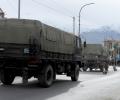
China is in no hurry to disengage at the border and the region and international community is moving on. The spectre of a long haul in Ladakh haunts India, points out Ambassador M K Bhadrakumar.
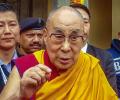
'The logical step is to challenge the very legitimacy of the Chinese claim over Tibet,' recommends Inspector General Gurdip Singh Uban (retd).

'The military aim in a future conflict, if it can't be avoided, should be to cause maximum damage to the adversary's war waging capability and capture limited amount of territory as a bargaining counter,' says Brigadier Gurmeet Kanwal (retd).
India has experienced hands and will emerge with flying colours, declares Inspector General Gurdip Singh Uban (retd).
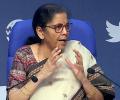
'The Modi government is about privatising profits and nationalising losses.'

The onus today is on China, but it also requires a little diplomatic finesse from India, backed by a modernised armed force, argues BJP MP Subramanian Swamy in this excerpt from his new book, Himalayan Challenge: India, China And The Quest For Peace.

The Congress kept sheltering Quattrochi, and the BJP was more intent on shielding the Hinduja brothers. The fact is that the two roads crisscrossed, and neither the truth prevailed nor did the law take its course, says Mohan Guruswamy.

The US election campaign has provided plenty of ammunition for the CCP to make its case that its political system is superior.

'If the Chinese intent is to be gauged based on its aggression in the South China Sea, greater forays in the Indian Ocean, a hawk's attitude towards Taiwan, flying its fighters repeatedly over the Senkaku islands in the East China Sea and creating strategic assets globally, there would be a requirement for strategic partnerships for India,' says Brigadier S K Chatterji (retd).

China is pulling out all the stops to give a 'state visit-plus' reception to Trump on his maiden visit.

The Chinese air force is now a 400,000-person force that flies some 2,000 combat aircraft -- more than thrice the size of the Indian Air Force.

'The intrusion in Chumar, during and beyond the Chinese president's visit, is unprecedented and has qualitatively changed the tone of the India-China relationship,' says Jayadeva Ranade, a member of the National Security Advisory Board.
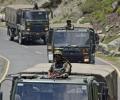
'The one aspect which no Indian military thinker would wish to see emerge is a LoC type of posture at the LAC.' 'The LoC is manned for 750 km and terrorist infiltration has led to the creation of a virtual fortress along its entire length.' 'Something mirroring this at the LAC is going to be expensive although deployment everywhere is not warranted there.' 'However, given the complete trust deficit, there appear few alternatives,' notes Lieutenant General Syed Ata Hasnain (retd).

'Islamic State has declared that the liberation of Islamic Xinjiang from China is an objective. Beijing may well find that Pakistan is unable to assist in any meaningful way,' says China expert Jayadeva Ranade.

Major General Sujan Singh Uban, a legendary veteran of the Second World War, was a natural choice to raise, train and command the Special Frontier Force and mould them into a well oiled fighting machine, recalls his son Inspector General Gurdip Singh Uban (retd), who led SFF troops during the Kargil War.

There are signs of China's external behaviour becoming more aggressive in the coming years. If that happens, strategic implications for neighbours having territorial disputes with China can become deeper and imperatives can rise for the former to counteract, says D S Rajan
How should sophisticated countries deal with others that have a huge body but a small brain?

'China, which had earlier blockaded New Delhi's bid to join the Nuclear Suppliers Group by citing the nuclear non-proliferation law, finds itself in an awkward position and international isolation.' 'India needs to pursue a policy of mediation between China and the Southeast Asian countries for regional security,' says Srikanth Kondapalli.
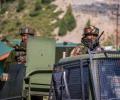
'Why has the peace been kept?' 'Basically because there is a balance.' 'Maybe they think that balance has changed.' 'People can make mistakes. People can miscalculate.' 'If that is the cause, then I think what we have done, matching their build-up, etc, it is giving a good account of ourselves in the face-offs.'
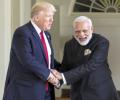
Trump lauds Modi, saying he has been working successfully to bring the vast country and its people together.

'Little did those in India's strategic community realise that any wise adversary in China's place and circumstances would only take the land route to disturb and trouble India.' 'It is along the land border that all of India's post-Cold War allies would be of little or no political and diplomatic, and least of all, military help,' says N Sathiya Moorthy.

'If I had not been elected President of the United States, we would right now, in my opinion, be in a major war with North Korea,' Trump said.

52 world leaders, including Narendra Modi, will attend this week's Nuclear Security Summit in Washington, DC. Obama will meet separately only with the Chinese president.

The decision to not attend the forum attended by 28 heads of state and 130 national delegations is a clear break from its usual policy of going along with the crowd.

Being a pragmatist Modi is not likely to give preference to China over Japan. Both security and economic aspects are likely to shape Modi's decision in terms of engaging the two biggest economies of Asia, says Sana Hashmi.

There is speculation that China released the White Paper on Tibet in a hurry after a Spanish court agreed to hear charges of genocide against former Chinese president Hu Jintao. Ajai Shukla reports

How will the Modi Sarkar's likely return affect other nations?

'There are major implications for India. Though there was a transparently thin attempt to project the troop reduction as intended to promote peace, the downsizing is actually part of plans to streamline and strengthen the PLA, capable of defending China's national interests at home and abroad,' says Jayadev Ranade.

'India should think big: About how in a multi-polar world, India can indeed be one of the poles, rather than being a secondary power that has to worry about 'alignment' with one of the poles. A G3 in other words, India should look to getting others to align with itself rather than the US or China,' says Rajeev Srinivasan.

One thing Beijing must understand is that India is not obsessed with being a threat to China but only wants a rightful place for itself in the world, says Sanjeev Nayyar.


'The creation of Pakistan was integral to Britain's grand strategy.' 'If they were to ever leave India, Britain's military planners had made it clear that they needed to retain a foothold in the NWFP and Baluchistan because that would provide the means to retain control of Iran, Iraq, Kuwait, the UAE, Bahrain and Qatar.'
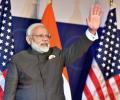
PM Modi addressed the Indian community in Washington DC after meeting chief executives of major US companies.


'Xi Jinping got a dose of Modi's medicine inside the tent where he was being hosted on the banks of the Sabarmati river.' 'Modi reportedly told him, looking deep into his eyes: "This was not expected of your country. Can you tell me when the troops are withdrawing?".'

'A plausible American tactic,' Rajeev Srinivasan suspects, 'would be to try and prevent the BJP and Modi from coming to power by splitting the anti-Congress vote using the AAP, and in case that fails, to follow up with a Plan B to make India ungovernable, to create mass conflict through their agents.'
